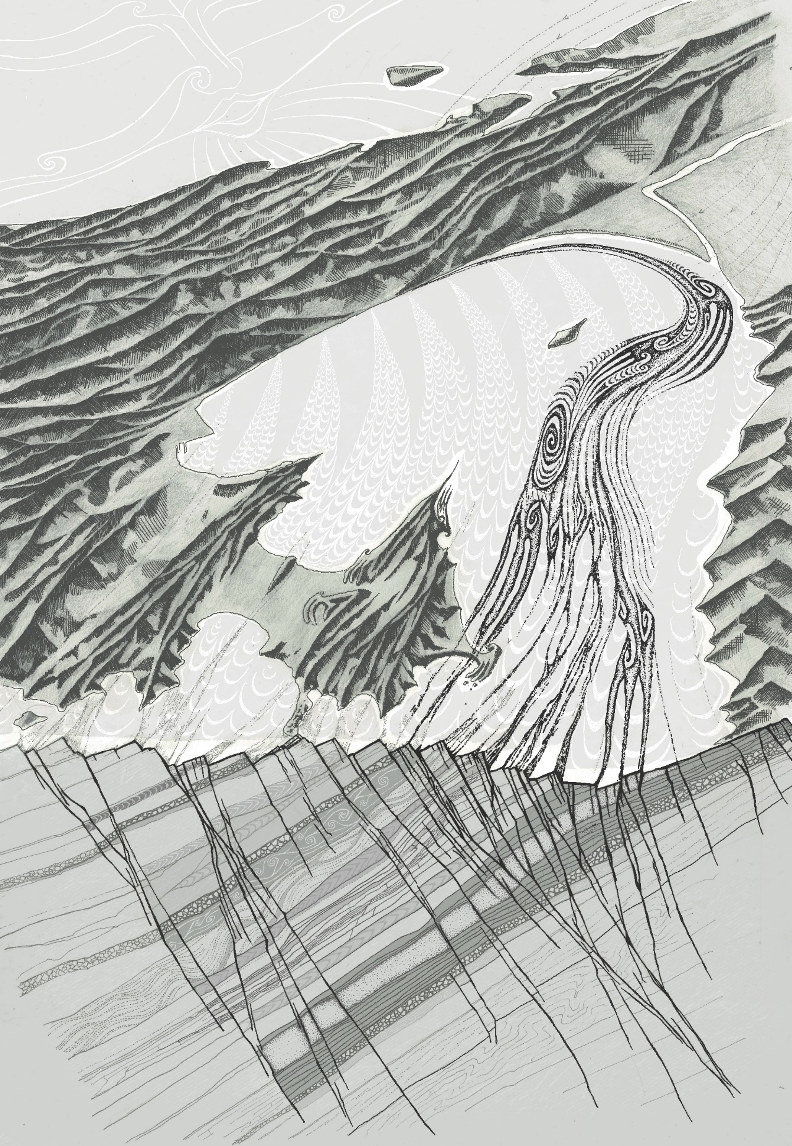
Te Karanga Ki Ngākengake The Call of the Shifting Forces
Keywords:
Te Ātiawa pūrākau; taniwha; waterfront design ; decolonisationAbstract
This design proposal extends and intensifies the powerfully present geological conditions of Te Whanganui-a-Tara–Wellington’s harbour. Originally conceived for an international design competition it contextualises the magnitude of geologic time and imagines an embodied experience of suspension, a quality of being between worlds yet in the felt immediacy of nothing but kenetic change. The design emerges from and is given meaning by Te Ātiawa pūrākau of taniwha Ngake and Whātaitai. Together these taniwha give the why and how of Pōneke Wellington’s land and seascape; they contextualise geomorphology in deep time and express the entangled alliance between mana whenua and the specificity of place, a quality defining Pōneke Wellington. With the design we touch into multiple relational intersections made possible by the forever mercurial space where the sea and the land meet, yet do so in such a way to unsettle settler colonial schemas of landscape-seascape experience.
Downloads
Downloads
Published
How to Cite
Issue
Section
License
Copyright (c) 2025 Hannah Hopewell, Matthew Wakelin

This work is licensed under a Creative Commons Attribution 4.0 International License.
Authors who publish with this journal agree to the following terms:- Authors retain copyright and grant the journal right of first publication with the work simultaneously licensed under a Creative Commons Attribution License that allows others to share the work with an acknowledgement of the work's authorship and initial publication in this journal.
- Authors are able to enter into separate, additional contractual arrangements for the non-exclusive distribution of the journal's published version of the work (e.g., post it to an institutional repository or publish it in a book), with an acknowledgement of its initial publication in this journal.
- Authors are permitted and encouraged to post their work online (e.g., in institutional repositories or on their website) prior to and during the submission process, as it can lead to productive exchanges, as well as earlier and greater citation of published work (See The Effect of Open Access).