
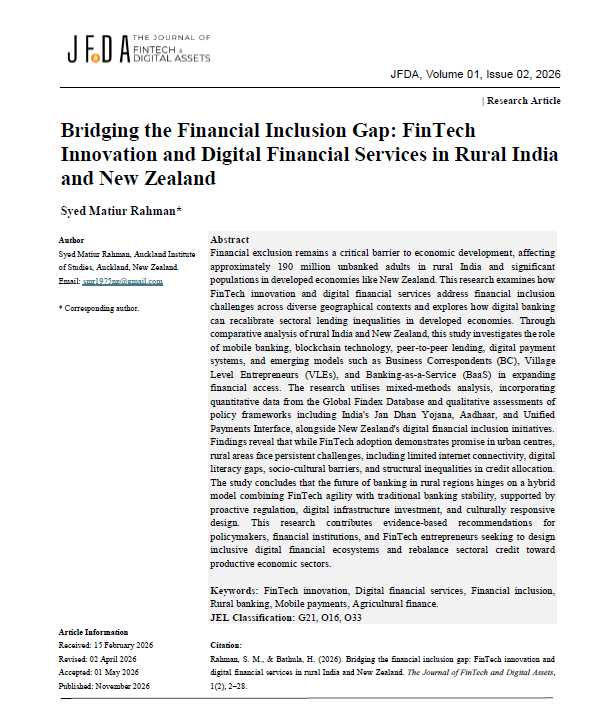
Bridging the Financial Inclusion Gap: FinTech Innovation and Digital Financial Services in Rural India and New Zealand
DOI:
https://doi.org/10.34900/jfda.v1i2.1379Keywords:
FinTech innovation; Digital financial services; Financial inclusion; Rural banking; Mobile payments;Abstract
Financial exclusion remains a critical barrier to economic development, affecting approximately 190 million unbanked adults in rural India and significant populations in developed economies like New Zealand. This research examines how FinTech innovation and digital financial services address financial inclusion challenges across diverse geographical contexts and explores how digital banking can recalibrate sectoral lending inequalities in developed economies. Through comparative analysis of rural India and New Zealand, this study investigates the role of mobile banking, blockchain technology, peer-to-peer lending, digital payment systems, and emerging models such as Business Correspondents (BC), Village Level Entrepreneurs (VLEs), and Banking-as-a-Service (BaaS) in expanding financial access. The research utilizes mixed-methods analysis, incorporating quantitative data from the Global Findex Database and qualitative assessments of policy frameworks, including India’s Jan Dhan Yojana, Aadhaar, and Unified Payments Interface, alongside New Zealand’s digital financial inclusion initiatives. Findings reveal that while FinTech adoption demonstrates promise in urban centers, rural areas face persistent challenges, including limited internet connectivity, digital literacy gaps, socio-cultural barriers, and structural inequalities in credit allocation. The study concludes that the future of banking in rural regions hinges on a hybrid model combining FinTech agility with traditional banking stability, supported by proactive regulation, digital infrastructure investment, and culturally responsive design. This research contributes evidence-based recommendations for policymakers, financial institutions, and FinTech entrepreneurs seeking to design inclusive digital financial ecosystems and rebalance sectoral credit toward productive economic sectors.
Downloads
Additional Files
Published
How to Cite
Issue
Section
License
Copyright (c) 2026 Syed Matiur Rahman

This work is licensed under a Creative Commons Attribution 4.0 International License.