
Value-at-Risk (VaR) Based Portfolio Optimization and Risk Decomposition
DOI:
https://doi.org/10.34900/jfda.v1i1.1376Keywords:
Value-at-Risk (VaR), Marginal VaR, Component VaR, Incremental VaR, Portfolio OptimizationAbstract
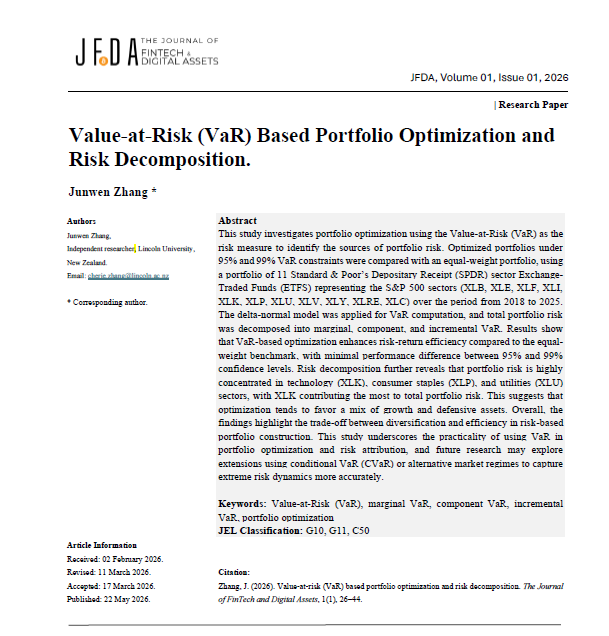
This study investigates portfolio optimization using the Value-at-Risk (VaR) as the risk measure to identify the sources of portfolio risk. Optimized portfolios under 95% and 99% VaR constraints were compared with an Equal-Weight Portfolio, using a portfolio of 11 SPDR sector Exchange-Traded Funds (EFTs) representing the S&P 500 sectors (XLB, XLE, XLF, XLI, XLK, XLP, XLU, XLV, XLY, XLRE, XLC) over the period from 2018 to 2025. The delta-normal model was applied for VaR computation, and total portfolio risk was decomposed into Marginal, Component, and Incremental VaR.
Results showed that VaR-based optimization enhances risk-return efficiency compared to the equal-weight benchmark, with minimal performance difference between 95% and 99% confidence levels. Risk decomposition further reveals that portfolio risk is highly concentrated in Technology (XLK), Consumer Staples (XLP), and Utilities (XLU) sectors, with XLK contributing the most to total portfolio risk. This suggests that optimization tends to favor a mix of growth and defensive assets.
Overall, the findings highlight the trade-off between diversification and efficiency in risk-based portfolio construction. This study underscores the practicality of using VaR in portfolio optimization and risk attribution, and future research may explore extensions using Conditional VaR (CVaR) or alternative market regimes to capture extreme risk dynamics more accurately.
Downloads
Downloads
Published
How to Cite
Issue
Section
License
Copyright (c) 2026 Junwen Zhang

This work is licensed under a Creative Commons Attribution 4.0 International License.