
Comparison of digital RMB and private payment platform Gap Analysis and Improvement
DOI:
https://doi.org/10.34900/jfda.v1i2.1370Keywords:
Digital RMB, WeChat Pay, Perceived usefulness(PU), Perceived ease of use(PEOU), Behavioral intentions to use digital RMB(BI)Abstract
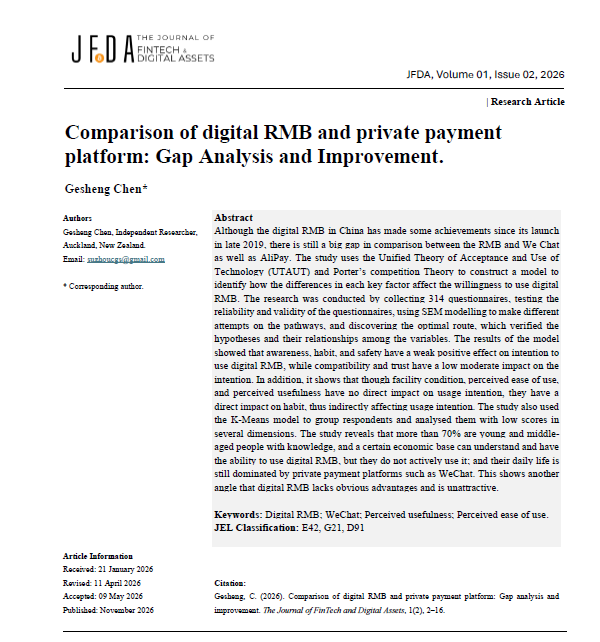
Although the digital RMB has made some achievements since its launch in late 2019, there is still a big gap between We Chat and Ali pay. The study uses the Unified Theory of Acceptance and Use of Technology (UTAUT) and Porter’s competition Theory to construct a model to identify how the differences in each key factor affect the willingness to use digital RMB. The research was conducted by collecting 314 questionnaires, testing the reliability and validity of the questionnaires, using SEM modelling to make different attempts on the pathways, and discovering the optimal route, which verified the hypotheses and their relationships among the variables. The results of the model showed that awareness, habit, and safety have a weak positive effect on intention to use digital RMB, while compatibility and trust have a low moderate impact on the intention. In addition, it was found that though facility condition, perceived ease of use, and perceived usefulness have no direct impact on usage intention, they have a direct impact on habit, thus indirectly affecting usage intention. The study also used the K-Means model to group respondents and analysed them with low scores in several dimensions, where more than 70% are young and middle-aged people with knowledge, and a certain economic base, who can understand and have the ability to use digital RMB, but they do not actively use it, and their daily life is still dominated by private payment platforms like We Chat, which shows from another angle that digital RMB lacks obvious advantages and is unattractive.
Downloads
Downloads
Published
How to Cite
Issue
Section
License
Copyright (c) 2026 Gesheng Chen

This work is licensed under a Creative Commons Attribution 4.0 International License.