
Stablecoins in Japan: Regulatory Architecture, Monetary Strategy, and the Construction of Hybrid Digital Money Infrastructure.
DOI:
https://doi.org/10.34900/jfda.v1i1.1361Keywords:
Cryptocurrency, Digital money, Japan, Regulation, StablecoinsAbstract
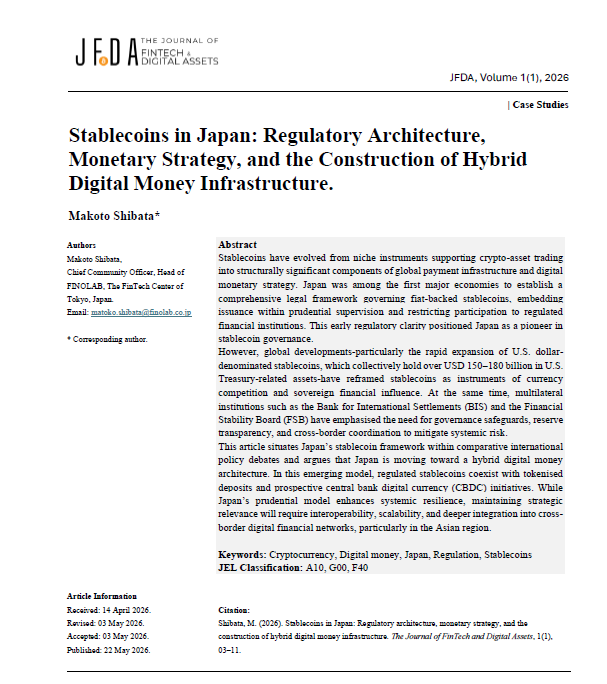
Stablecoins have evolved from niche instruments supporting crypto-asset trading into structurally significant components of global payment infrastructure and digital monetary strategy. Japan was among the first major economies to establish a comprehensive legal framework governing fiat-backed stablecoins, embedding issuance within prudential supervision and restricting participation to regulated financial institutions. This early regulatory clarity positioned Japan as a pioneer in stablecoin governance.
However, global developments-particularly the rapid expansion of U.S. dollar-denominated stablecoins, which collectively hold over USD 150–180 billion in U.S. Treasury-related assets-have reframed stablecoins as instruments of currency competition and sovereign financial influence. At the same time, multilateral institutions such as the Bank for International Settlements (BIS) and the Financial Stability Board (FSB) have emphasised the need for governance safeguards, reserve transparency, and cross-border coordination to mitigate systemic risk. This article situates Japan’s stablecoin framework within comparative international policy debates and argues that Japan is moving toward a hybrid digital money architecture. In this emerging model, regulated stablecoins coexist with tokenised deposits and prospective central bank digital currency (CBDC) initiatives. While Japan’s prudential model enhances systemic resilience, maintaining strategic relevance will require interoperability, scalability, and deeper integration into cross-border digital financial networks, particularly in the Asian region.
Downloads
Downloads
Published
How to Cite
Issue
Section
License
Copyright (c) 2026 Makoto Shibata

This work is licensed under a Creative Commons Attribution 4.0 International License.